

Retro bathrooms have a built-in advantage: they were designed around materials made to last, like glazed tile, porcelain, chrome, and glass. That is a big reason a pastel-tiled bath or a black-and-white checkerboard floor can still look fresh decades later. The trick is knowing which parts of a vintage look to borrow and which to leave behind.
The 20 retro bathroom ideas below stretch from the 1930s through the 1970s and range from small renter-friendly swaps to full tile and fixture projects. Each one explains what the look depends on, how to adapt it to a modern home, and where it tends to go wrong, so you can bring in vintage charm without the room feeling like a costume.
1. Soft Rose Tile With a Black Trim Line
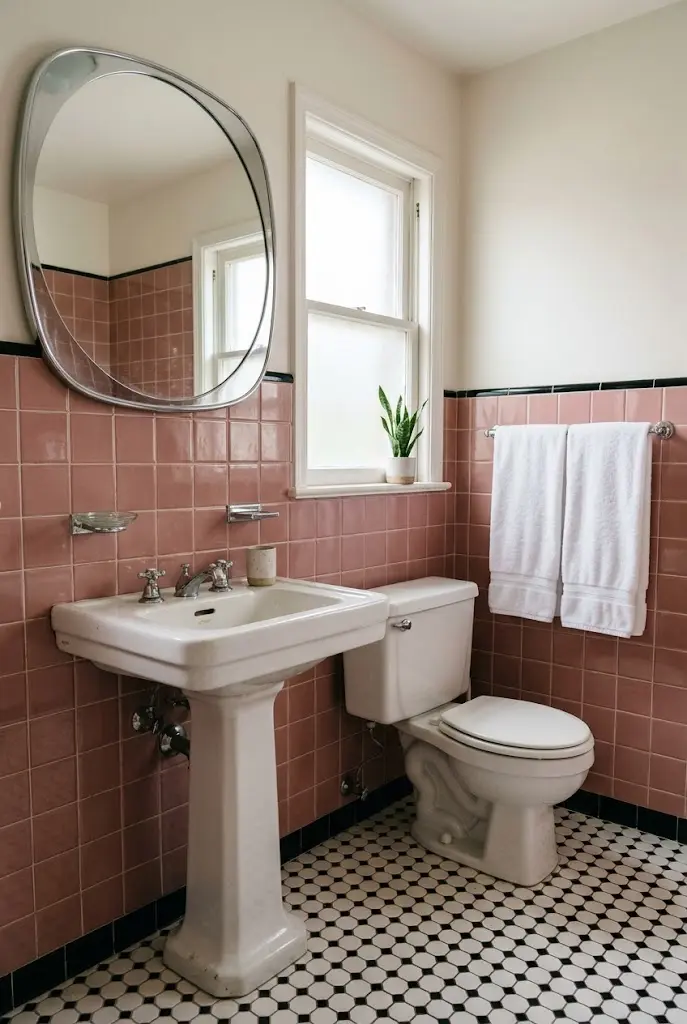
Pink bathrooms are the most recognizable symbol of mid-century American design, and a wall of soft rose tile still reads as bold without being loud. Glossy 4-inch tile in a plain grid is the simplest way to get there, and a thin black or deep green trim line at chair-rail height gives the wall the layered finish that period bathrooms had.
To keep it wearable, let the pink do the talking and keep everything else quiet:
- White fixtures and a white ceiling let the tile read as the feature rather than the whole room.
- A dusty, slightly warm rose ages better than a candy pink.
- Chrome or polished nickel hardware sits closer to the era than matte black.
Warm white or pale gray grout is kinder to this color than stark bright white, which can make the grid look harsh.
2. A Diagonal Black-and-White Checkerboard Floor

A checkerboard floor does the work of wallpaper and rug at once. Set on the diagonal, the squares pull the eye across the room, which can make a narrow bathroom feel wider than it is. Set square to the walls, the pattern feels calmer and more traditional.
Do: Choose a tile size in proportion to the room. Smaller squares usually suit a compact bath better than oversized ones, and a mid-gray grout is more forgiving than white.
Don’t: Add heavily patterned wall tile on top of it. Let the walls stay a solid color so the floor is the single graphic moment.
Porcelain or ceramic is the durable route. Quality vinyl is a lower-cost way to get the same pattern when a full tile job isn’t realistic.
3. Mint Green Tile Balanced With Cream

Mint green was a staple of 1950s bathrooms, appearing in tile, tubs, and sinks. It works best when treated as a soft neutral: pair it with cream or warm white instead of stark white, and add a small hit of coral or butter yellow through towels or a stool.
Colored fixtures can be hard to find new, so a practical route is mint tile with standard white fixtures. If you want the full vintage effect, restored or refinished original pieces are another option.
Editor’s Note: Mint can look cold under cool-white bulbs. Warm white bulbs, often labeled around 2700K, keep it looking soft instead of clinical.
4. Hexagon Mosaic Floors in Three Different Moods
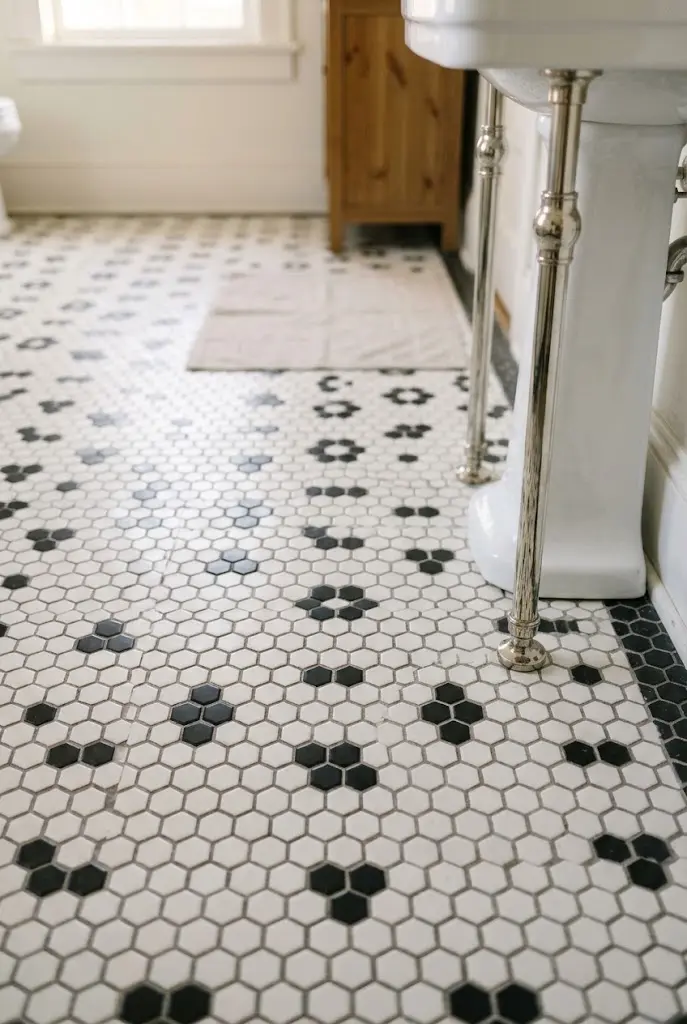
Small hexagon mosaic tile is a hallmark of early-1900s bathrooms. The many small pieces follow slightly uneven older floors more easily than large tile, and the extra grout lines can add grip underfoot. The pattern you choose changes the personality of the whole room.
| Pattern | Effect | Best Fit |
|---|---|---|
| All-white hex with gray grout | Quiet texture, vintage without contrast | Small baths that need to stay light |
| Black-and-white flower or border pattern | Classic early-20th-century character | Rooms with plain, simple walls |
| Single-color matte hex in sage or blue | Soft color with texture | Baths with white or wood-toned walls |
The flower pattern is the most decorative of the three, so keep the surrounding details restrained.
5. Glossy White Subway Tile With Charcoal Grout

Plain white subway tile feels entirely different when the grout turns charcoal. The grid becomes a graphic line drawing across the wall, a look closely tied to early-20th-century transit stations and old-fashioned baths. Charcoal tends to feel softer than true black.
Tips & Tricks
- Running bond (offset) gives the classic look; a vertical stack feels more modern.
- Glossy glaze bounces light, which helps a bathroom with a small window.
- Check a grout sample dry and under your actual bathroom lighting, since color shifts as it cures.
- Pair with a simple exposed shower valve and chrome head to keep the look consistent.
6. A Clawfoot Tub With Exposed Plumbing

A freestanding clawfoot tub gives a bathroom one clear focal point, and exposed supply pipes with cross handles finish the vintage look. It suits rooms with enough floor space to let the tub stand away from the walls, ideally near a window.
Common Mistake: Pushing the tub tight into a corner so there is no way to clean behind or around it.
Better Approach: Leave a small clearance on all sides, then choose a floor-mounted or wall-mounted supply setup that suits the layout. Cast iron tubs are heavy, so on an upper floor it is worth asking a contractor to confirm the floor can carry the load.
With the tub as the star, keep the rest of the room simple: painted wood floors, white wall tile, and one or two shelves are plenty.
7. A Pedestal Sink With Cross-Handle Taps

A pedestal sink clears floor space and keeps the bathroom visually open, which is why it shows up in so many older homes. Pair it with separate cross-handle taps or a classic bridge faucet for an unmistakable vintage cue.
The tradeoff is storage. A pedestal gives you almost none, so plan for it with a wall ledge, a recessed shelf, or a narrow cabinet nearby rather than leaving the room without a place for everyday items.
Quick Tip: Mount a slim wood or glass ledge about a hand’s width below the mirror for a toothbrush cup and soap dish. It keeps the sink area tidy without adding bulk.
8. Beadboard Wainscoting With a Painted Upper Wall

Beadboard brings cottage-style vintage charm to a bathroom and can be done in stages. The idea is a painted paneled lower wall topped with a cap rail, and a soft color above.
- Choose the height. Somewhere around waist to chest height usually looks balanced.
- Pick the right material. In a bathroom, PVC or moisture-resistant panels are safer than standard MDF, which can swell with humidity.
- Finish the top edge. A simple cap rail makes the paneling look built-in.
- Paint appropriately. Use a semi-gloss or bathroom-rated paint below, and a softer color above.
Pale sage, soft blue, and warm white are classic upper-wall colors that keep the paneling at the center.
9. Harvest Gold and Avocado: The 1970s Palette
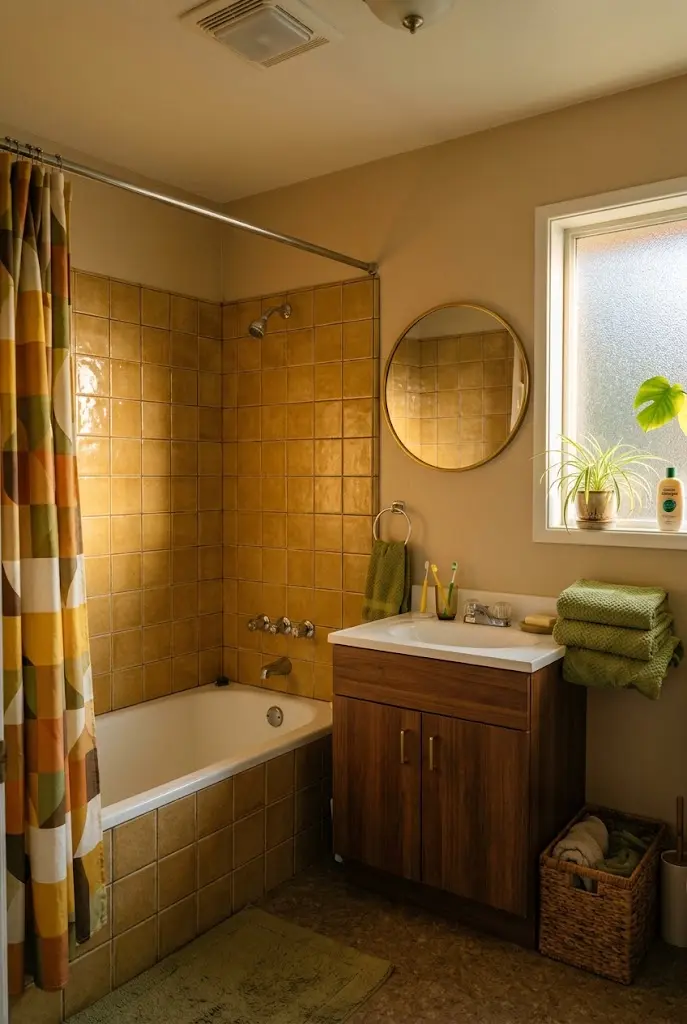
Harvest gold, avocado green, burnt orange, and warm brown define the 1970s bathroom. Used in small doses, they feel warm and playful. Used everywhere, they can feel heavy, so decide how far you want to go.
| Approach | What It Looks Like | Best For |
|---|---|---|
| Accent | Gold towels, an avocado glass bottle, wood tones against white tile | Renters and first-time retro decorators |
| Full commitment | Gold or avocado tile, warm wood vanity, patterned curtain | Remodels where the tile will stay for years |
Warm wood, cane, and woven textures help the palette feel current. Keep walls and ceilings in a creamy white and let the color come from tile and accessories.
10. Bold Retro Wallpaper in a Powder Room

A powder room is the safest place to try a loud pattern, since there is no shower putting moisture into the walls. Think oversized 1960s-style florals, mod geometrics, or botanical prints in orange, olive, and cream.
Tips & Tricks
- Use vinyl or bathroom-rated wallpaper if the room has a shower or little ventilation.
- Paint the ceiling a color pulled from the pattern for a wrapped-in effect.
- Keep the mirror frame simple so it does not compete with the wallpaper.
- Choose one wallpaper and let the fixtures stay plain white.
11. An Art Deco Powder Room in Black and Brass

Art Deco bathrooms of the 1920s and ’30s relied on geometry, strong contrast, and metallic accents. In a modern powder room, that translates to glossy black tile or a black-painted wainscot, thin brass trim, and a fan or sunburst-shaped mirror.
Best For: Powder rooms and small baths where drama is welcome
Investment: Moderate to premium with tile and custom metalwork; accessible if you paint a vanity glossy black and swap in brass-finish hardware
Visual Effect: Graphic, polished, and a little theatrical
Keep the white marble or white-surfaced vanity top clean and simple so the contrast stays crisp, and use warm bulbs so the brass glows instead of looking flat.
12. Powder-Blue Tile Paired With Chrome
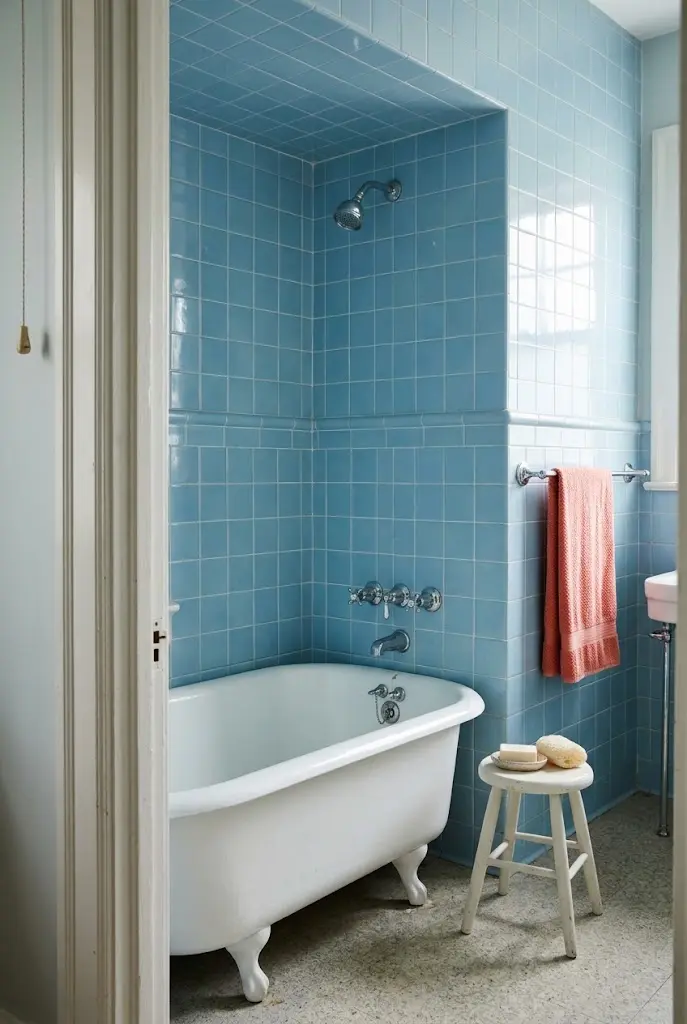
Powder blue is the cooler cousin of mint and pink, and it feels clean and calm in a tub-and-shower alcove. Carry the tile to the ceiling for a cohesive, enclosed look, and keep the fixtures chrome and white.
Blue tile can feel icy in a bathroom with little daylight, so add warmth through materials: a wood stool, cream towels, or a small hit of coral.
Quick Tip: A single coral or butter-yellow towel against powder blue looks intentional, while several competing accents can make the room feel busy.
13. A Recessed Medicine Cabinet With a Beveled Mirror
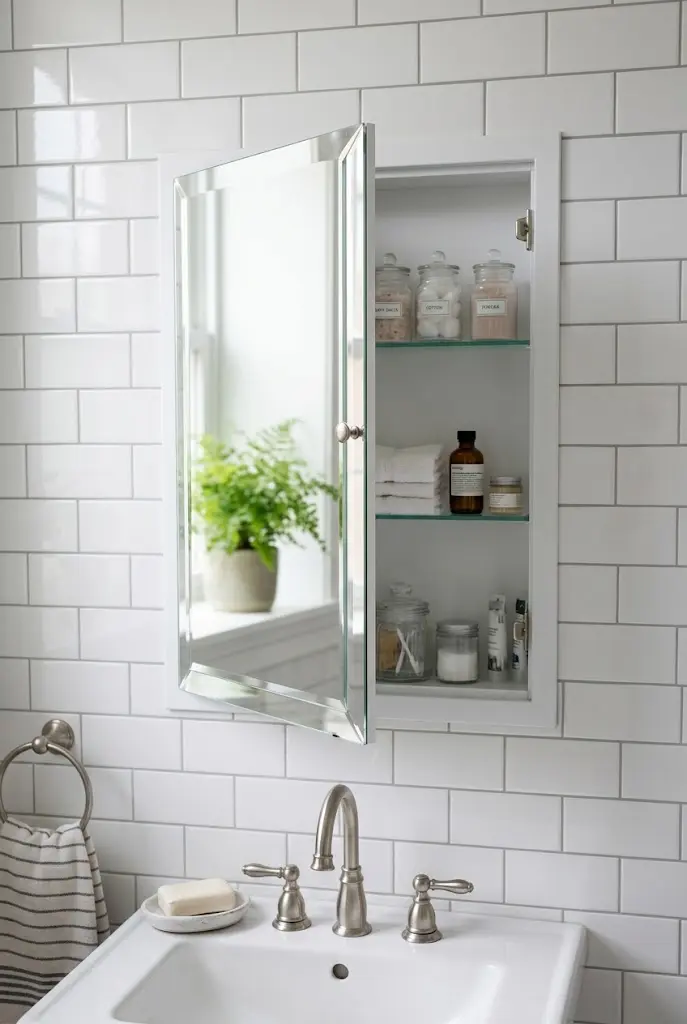
A recessed medicine cabinet sits flush with the wall, which keeps a small bathroom clear while adding real storage. A beveled mirror edge is the classic vintage detail, catching light along its border.
- Look for a flush-mount or recessed model with a simple white or nickel frame.
- Choose a mirror door that opens fully so shelves are easy to reach.
- Before cutting into the wall, check for studs, wiring, and plumbing, and consider hiring a professional if you are not sure.
The result is storage that looks original to the house rather than added later.
14. Opal Glass Schoolhouse Sconces

Opal or milk-glass globes on slim metal arms have a long history in bathrooms, and for good reason: the diffused glow flatters faces and softens hard tile surfaces. Mount a pair at about eye level on either side of the mirror for even light across the face.
In a bathroom, check that fixtures are rated for damp locations, especially anywhere near a shower. Warm white bulbs will keep painted walls and wood tones looking natural.
Editor’s Note: Sconces on both sides of the mirror usually give more even light than a single fixture above it, which can cast shadows under the eyes and chin.
15. Terrazzo Floors and Counters

Terrazzo, made of marble or stone chips set in a binder, was widely used in mid-century buildings and is now back in homes. Its speckled surface hides everyday marks and suits bathrooms that want a pop of pattern without a loud color.
| Option | Character | Investment |
|---|---|---|
| Poured-in-place terrazzo | Seamless, custom, most authentic | Premium |
| Terrazzo tile | Easier to install, wide range of chip colors | Mid-range |
| Terrazzo-look porcelain | Similar speckled appearance, different material | Accessible to mid-range |
Terrazzo-look porcelain borrows the design principle rather than the material itself, so expect a similar look but not an identical one. Choose a base color and chip palette that match your wall and fixture colors.
16. Glass Block for Light and Privacy

Glass block was common in bathroom windows and shower walls from the mid-century years into the 1980s. It lets light pass while blurring the view, which is why it suits bathrooms that need privacy but still want daylight.
- Window: Replaces a standard window with a patterned, light-scattering panel.
- Shower wall: Creates a partial wall without a door or curtain.
- Texture: Patterns range from clear to wavy to ribbed, each scattering light differently.
Glass block is heavy, and installing it in a structural opening is a job for a professional. Pair it with warm taupe or cream tile so the room does not feel cold or dated.
17. Renter-Friendly Retro: Textiles, Hardware, and Mirrors

Not every retro bathroom needs a remodel. In a rental or a small apartment, the look comes from the pieces that move with you.
- A striped or gingham shower curtain in red, cream, or sage.
- A scalloped cotton bath mat and a stack of thick white towels.
- A round or oval vintage-style mirror hung over the sink.
- Swapped cabinet knobs, or a swapped towel bar. Save the originals so they can go back before move-out.
Mix a few metals sparingly, like chrome and nickel, and keep colors to two or three to avoid a themed look. The aim is a room that feels collected, not decorated from a catalog.
18. Pale Yellow Tile With a Black Border

Soft yellow tile outlined with a black border was a signature of 1930s bathrooms. The pairing feels fresh because the yellow stays gentle while the black keeps it from drifting sweet.
Common Mistake: Choosing a bright, saturated yellow that overwhelms a small room.
Better Approach: Choose a pale, creamy yellow and let the black bullnose or border row carry the contrast.
Black-and-white floor tile and white fixtures keep the palette crisp. A matching black switch plate or towel hook is a small detail that makes the room feel intentional.
19. An Antique Dresser Turned Bathroom Vanity

A repurposed dresser or sideboard gives a bathroom furniture-like character, and it is one of the more personal ways to add vintage charm. Paint it in a soft blue-gray or deep green and finish it with porcelain knobs.
Common Mistake: Leaving the wood unsealed, where steam and splashes can damage it over time.
Better Approach: Seal the finish with a water-resistant coating, use a stone or other water-resistant top, and have a plumber handle cutouts for the sink and drain. A vessel sink or a drop-in basin both work, and a wall-mounted faucet keeps the top clear.
Old drawers can lose some depth to plumbing, so plan on one or two usable drawers rather than a full set.
20. A Floating Teak Vanity With a Round Mirror

Mid-century modern bathrooms trade ornament for clean lines and natural wood. A wall-mounted teak or walnut vanity keeps the floor visible, which makes a small room feel larger, and a round mirror softens the straight lines.
Best For: Small and mid-sized baths that want a calm, modern-vintage look
Investment: Mid-range to premium, depending on whether the vanity is custom or ready-made
Visual Effect: Warm, light, and uncluttered
Teak is naturally oil-rich and often used in damp settings, but a sealed finish still helps in a bathroom. Pair it with white or pale plaster-textured walls, simple brass or nickel fixtures, and one patterned element, such as a geometric tile or wallpaper strip.