

Light, airy rooms get most of the attention, but a living room that feels like a deep breath often leans the other way. Saturated paint, dense fabrics, and surfaces you want to touch can make a space feel enclosed in the best sense: calm, layered, and made for long evenings. The catch is that deep color alone doesn’t create comfort. Texture does the heavy lifting, giving dark tones enough variation that they read as rich instead of flat.
These 11 cozy living room ideas pair moody color with materials like wool, velvet, limewash, leather, and bouclé. Some take a weekend and a gallon of paint. Others are a carpenter’s project. All of them show how to make depth feel inviting rather than heavy.
1. Wrap the Room in Forest Green With Warm Walnut Furniture
Deep green is one of the easiest dark colors to live with because it behaves almost like a neutral. Painted on all four walls, a muted forest or spruce shade makes oak and walnut look richer and lets brass, cream linen, and leather settle in without competing. Choose a green with a hint of gray or black in it. Brighter, yellow-leaning greens can turn acidic under warm bulbs.

Pair the walls with a walnut media console or coffee table, an oatmeal-colored sofa, and a wool rug with a soft, low-contrast pattern. The light upholstery keeps the room from feeling heavy, while the wood adds the warmth green sometimes lacks. A matte or eggshell finish hides wall imperfections better than satin, which helps in older homes.
Best For: rooms with at least one good window
Investment: moderate (paint plus a few quality wood pieces)
Visual Effect: enveloping and calm, with warm wood standing out against the walls
2. Anchor Pale Greige Walls With a Navy Velvet Sofa
Not everyone wants dark walls. A single deep navy sofa can deliver the same sense of depth while leaving the room flexible. Against soft greige walls, navy velvet becomes the room’s center of gravity, and the pile catches light differently across the seat, back, and arms, which adds dimension without any pattern.

Keep everything around it quieter: a jute or flatweave rug, a black metal side table, and pillows in oatmeal, mustard, or camel. The fabric choice matters as much as the color.
| Fabric | Look | Best Fit |
|---|---|---|
| Classic velvet | Deep sheen that shifts color as light moves across it | Adult-only or lower-traffic living rooms |
| Performance velvet | Slightly flatter sheen, designed for easier cleaning | Homes with kids or pets; check the maker’s cleaning code |
If you’re shopping on a budget, a slipcover or a well-priced ready-made sofa in navy gives you most of the effect. Save the splurge for the seat cushions’ fill and frame quality, since those determine how the sofa feels in a year.
3. Build a Burgundy Reading Corner
If a full dark room feels like too much, commit to one corner. Wine and oxblood shades read warm and slightly old-world, which suits a spot meant for books and a lamp. The corner approach is also forgiving: it’s a small paint job, and it turns an unused edge of the room into the place everyone fights over.
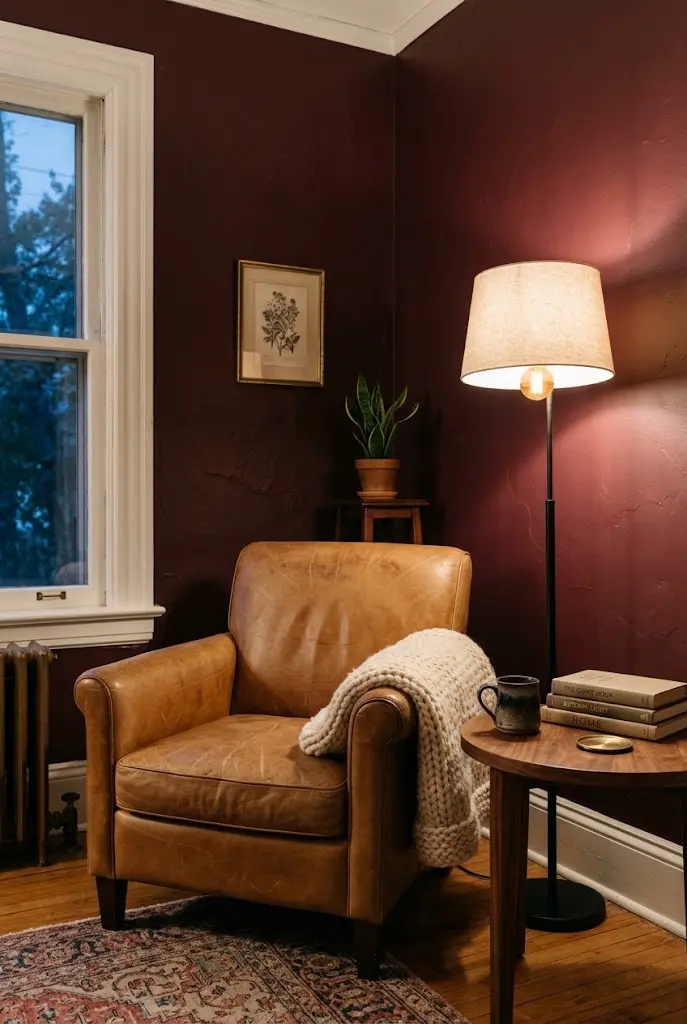
- Choose the corner. Pick one near a window or an outlet so lighting is easy. Paint both walls in a deep burgundy, and carry the color onto the baseboard and any trim for a wrapped look.
- Add one chair with texture. Camel leather or cream bouclé stands out against the dark walls and keeps the corner from disappearing.
- Layer the lighting. A swing-arm sconce or a slim floor lamp with a warm bulb gives you a reading pool of light and makes the paint glow.
- Finish small. A narrow side table, a stack of books, and a wool throw complete it without crowding the walkway.
Renters should check lease terms first, since repainting a dark color takes extra coats. A large framed textile or a deep-red painted canvas can create a similar mood without touching the wall.
4. Soften Charcoal Limewash Walls With Layered Linen
Limewash gives dark walls something paint rarely does: movement. The finish shows soft cloud-like variation, so a charcoal wall looks like stone or aged plaster rather than a flat block of color. That variation is what keeps a dark room from feeling like a cave.

Balance it with materials that have their own softness: floor-length linen curtains hung high, a boucle or linen sofa, raw wood, and a ceramic lamp with an imperfect glaze. Warm bulbs matter here, because cool light turns charcoal harsh.
Common Mistake: Rolling limewash on evenly and trying to hide every stroke, which makes it look like patchy regular paint.
Better Approach: Use a wide brush, apply thin coats in crisscross strokes, and let the variation show. Test on a sample board first, since results depend on the product and the wall surface underneath, and follow the maker’s prep instructions.
5. Pair a Chocolate Leather Sofa With a Chunky Wool Rug
Sometimes the deep color is the furniture itself. A chocolate or espresso leather sofa brings darkness without a single can of paint, and it improves with wear as the surface softens and develops character.

The room around it works best when it’s lighter and nubby:
- Walls: warm white or pale plaster, so the leather stands out as the room’s dark note
- Rug: a thick wool or wool-blend in cream and oat, with a low-contrast pattern
- Pillows: cream knit, rust linen, and one tweedy piece in brown
- Coffee table: travertine or pale oak to lift the visual weight
- Throw: an open-weave blanket draped over one arm
In practice, leather performs best away from heating vents and direct afternoon sun, both of which can dry or fade it over time. A rug pad under the wool also keeps the pile from bunching up under a heavy sofa.
6. Surround the Fireplace With Deep Teal Built-In Bookcases
Custom shelving on either side of a fireplace is one of the most architectural ways to add color. In a deep teal or peacock-green, the millwork reads like part of the house rather than furniture, and the shelves become a frame for books, ceramics, and art.

A few details separate a convincing version from a flat one. Paint the shelf backs the same deep color so objects stand out. Add shallow integrated lighting or a slim picture light, because dark finishes can swallow shadows. Mix book spines with ceramics, a few framed pieces, and some empty space so the shelves breathe.
Editor’s Note: Deep colors can make a shelf look crowded faster than light ones. Edit the styling in groups of three and leave at least a few shelves with room around each object.
Borrowing the principle: Two matching freestanding bookcases placed on either side of a fireplace or window, anchored securely to the wall and painted in the same teal, deliver the same symmetrical effect at a fraction of the price. They won’t have the seamless fit of true built-ins, but the color and structure carry the look.
7. Layer Rust and Terracotta Textiles Over a Neutral Base
Deep color doesn’t need paint. If your walls and sofa are neutral, a collection of rust, terracotta, and brown textiles can bring the same warmth and is easy to swap seasonally. It’s also a good fit for renters.

Tips & Tricks
- Combine three textures in the same warm family: one smooth (velvet), one nubby (wool or bouclé), and one woven (linen or flatweave).
- Vary the pillow sizes. A mix of 20-inch and 22-inch squares plus one lumbar looks collected rather than matched.
- Repeat the color somewhere away from the sofa, such as a terracotta vase on a shelf, so it feels planned.
- Add a throw in a deeper shade, like cocoa or oxblood, to ground the lighter rust pieces.
- Keep the rug neutral, since too many patterns will compete with the pillows.
8. Paint One Aubergine Wall and Add Bouclé Chairs
Plum and aubergine are underused, and that’s part of their appeal. A single deep purple wall behind the sofa feels distinctive without the commitment of painting every surface, and the color has enough red in it to feel warm in lamplight.

The bouclé chairs are the softener. Cream or oatmeal bouclé gives the dark wall something to push against, and its looped texture reads as inviting even in a photograph. Add a round coffee table with a brass edge to echo the curves.
Do
- Test the paint on the wall in morning and evening light, since plum can shift toward gray or blue.
- Choose the wall you see first when you walk in.
- Add warm metals like brass or bronze.
Don’t
- Pair it with cool gray everything, which can make the plum look dull.
- Choose a wall interrupted by several doors and windows, since the color won’t read as a clean backdrop.
- Skip a primer if you’re covering a light color; deep shades need an even base.
9. Paint the Fireplace Surround Black and Set It Against Warm White
A black fireplace is a graphic, high-contrast take on deep color. Against warm white walls, the surround becomes the room’s focal point, and the contrast makes even a plain mantel feel intentional. A honed stone hearth, aged brass candlesticks, and a simple round mirror keep it from feeling stark.
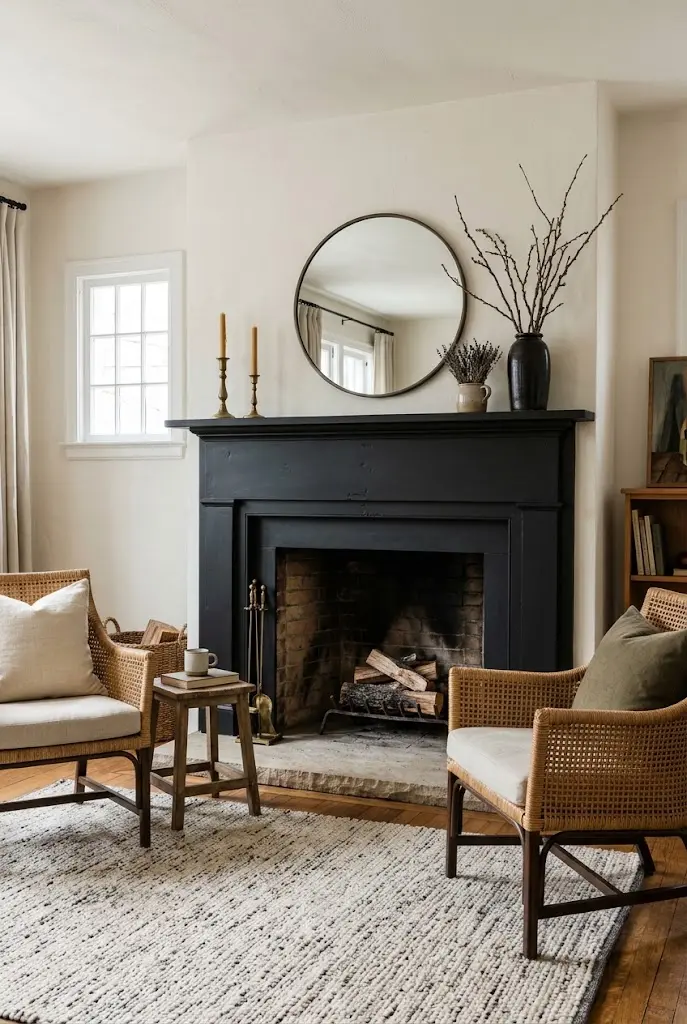
Soften the look with a wool rug in front, a pair of rattan or cane chairs, and a bundle of branches in a ceramic vase. The mix of matte black, natural fiber, and warm metal gives the corner depth.
Quick Tip: For areas close to the firebox opening, use paint rated for heat and follow the manufacturer’s instructions and local safety guidance. Standard wall paint isn’t designed for those surfaces.
10. Use Olive and Ochre to Warm Up a Small Apartment Living Room
Dark colors in a small room can feel heavy if they’re everywhere. The better approach is restraint: one olive wall, with ochre repeated in smaller accents. Olive recedes slightly, so it doesn’t crowd the room the way a darker navy might, and ochre adds a glow that makes the whole palette feel sunlit.

Before, a pale rental living room tends to feel flat, with everything the same softness and nothing for the eye to hold. After, one olive wall behind the sofa gives the room a clear backdrop, while ochre pillows, a jute rug, a rattan chair, and a trailing plant add layers of texture.
The principle is to repeat the deep color two or three times across the room so it feels deliberate. Mirrors opposite a window can also bounce daylight back into the darker wall.
11. Choose Warm Umber Plaster Walls and a Sculptural Stone Table
For a more architectural approach, consider walls finished in a deep umber or mocha plaster. Hand-troweled finishes have subtle variation in sheen and depth that flat paint can’t fully match, and they create a quiet, enveloping backdrop for a few well-chosen pieces.

Keep the furnishings minimal and sculptural: a low bouclé sofa, a thick stone coffee table with an organic shape, a single oversized floor lamp, and one large piece of art. The restraint is what keeps a dark plaster room feeling calm instead of dramatic.
Editor’s Note: Plaster work depends heavily on the applicator’s skill, so look at finished examples before hiring. A clay-based or limewash paint in a similar shade can approximate the mood for less, though it won’t replicate the depth of true plaster.